

“This winery was awarded a gold medal
during the 1885 governmental course”
The Castle and Estate of Coiano, a Historic Tuscan Farm
From the Etruscans to the Romans: The Ancient History of Coiano
The Castle of Coiano stands on fertile lands that have been prized since the 3rd century BC, first by the Etruscans and later by the Romans, who settled here.
Evidence comes from excavations carried out between 1986 and 1989 at Poggio Carlotta, where artifacts were recovered and are now displayed in the second room on the ground floor of the Archaeological Museum at Palazzo Pretorio in Montaione.
Building materials, ceramics, and animal bones tell the story of a settled population that raised pigs, sheep, and cattle for both labor and food.
Findings such as cups, trays, and drinking vessels for water and wine, as well as pantry containers and pottery used for kneading and cooking, reflect a developed society already skilled in the creation of ceramics, and in crafting tools from deer antlers.
The Visit of the Archbishop of Canterbury
It was toward the end of the 10th century that the Castle of Coiano became an important stop for rest and refreshment, thanks to its strategic location along what would later be known as the Via Francigena.
In the travel diary of Sigeric, Archbishop of Canterbury — the highest spiritual authority of the Anglican Church — there is mention of his stay at the Castle of Coiano during his return journey to England.
He was coming back from Rome, where he had received the Pallium — a symbol of archiepiscopal dignity and authority — from Pope John XV.
1100 – 1369: Coiano under the District of San Miniato
According to the 1337 Statute of San Miniato, every land, village, and walled fortress within the district was obliged to maintain a certain number of soldiers armed with halberds, lances, and crossbows.
The Castle of Coiano was a significant stronghold, staffed by 50 armed soldiers. Together with the Castle of Barbialla, it formed a vital outpost for the survival of the Ghibelline San Miniato, with lookout points facing both the Siena and Florence sides. In times of danger, the alarm bell was sounded by hammering. At night, if three bonfires were lit on the tower, all were required to immediately report to the captain of the people.
The Castle of Coiano hosted Emperor Enrico VI and Pope Giulio della Rovere. Several other prominent figures also stayed there, protected by the large garrison.
In 1297, Coiano was the site of the only hospital in the area, which also served the Castle of Barbialla.
In 1369, Coiano and Barbialla, along with the surrounding territories, came under the rule of the Florentine Republic, which entrusted them to the Albizzi family. The Albizzi appointed a magistrate to oversee the two fortresses and their lands.
1369 – 1603: The Àlbizzi Era at Coiano
Coiano remained under the influence of the Àlbizzi family—one of the most prominent and respected Florentine families, wealthy wool merchants and members of the Black Guelphs—for two and a half centuries, until 1603 when the Pucci family took over.
During the 14th century, the Àlbizzi held the highest offices in Florence, with as many as 98 priors and 13 gonfaloniers of justice. After the death of Maso degli Àlbizzi, his son Rinaldo took leadership. Rinaldo became the main rival of Cosimo de’ Medici, known as “il Vecchio,” alongside Palla Strozzi. Their rivalry and Rinaldo’s lack of decisiveness led to his downfall and the subsequent rise to power of Cosimo il Vecchio, who initiated a radical renewal of Florence’s ruling class.
The last descendant of the family was Vittorio di Alessandro Piero degli Àlbizzi, who introduced new viticulture methods in the Pomino area.
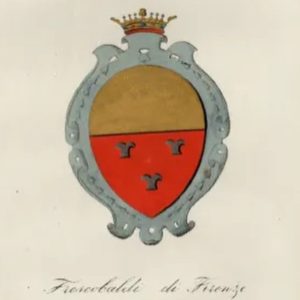
Upon his death in 1877, his assets passed to his sister Leonia, wife of Angelo Frescobaldi, a member of the Marchesi de’ Frescobaldi family.

From the Pucci to the Venturi: Florentine Families at Coiano
In 1603, the Castle of Coiano passed to the Pucci family, an ancient Florentine lineage that included prominent figures such as clergy, politicians, and notable citizens, as well as patrons, poets, and writers.
Always allies of the Medici, the Pucci were among the most influential families in the political life of Cosimo de’ Medici during the Renaissance. When Cosimo was imprisoned before his exile, it was Puccio Pucci who intervened to improve his prison conditions.
A curious fact: among the Pucci descendants is Emilio Pucci, the fashion designer and entrepreneur who founded the eponymous fashion house after World War II and became famous—especially during the 1960s and ’70s—for his extravagant yet refined clothing designs.
In 1603, Sibilla Pucci married Cosimo di Giovan Battista Venturi, bringing as dowry the Coiano estate along with a portion of her family’s archive.
The Coiano properties remained with the Venturi family until 1817, when Ippolito Venturi, the last descendant, died. The estate then passed to his niece Carolina Venturi, with the obligation to continue the family name.
From her marriage to the Lucchese nobleman Paolo Lodovico Garzoni came the daughters Chiara and Marianna Garzoni Venturi. Chiara managed the family assets, including those of Carmignano and Coiano, where she lived all her life.
Upon her death on December 29, 1871, the Castle of Coiano passed to her daughter Carolina Antonia Schneiderff, known as Carlotta. Coiano was about to enter its period of greatest splendor.
The Height of Coiano’s Splendor
Countess Carlotta was born in 1832. On June 18, 1849, at just 17 years old, she married Count Giulio Dainelli Masetti da Bagnano, a nobleman from Vinci, who died prematurely at the age of 30 in 1854. Widowed at only 22, she found herself managing the family business and quickly demonstrated great entrepreneurial spirit and exceptional management skills.
In 1885, she completely renovated the cellars of the Castle of Coiano, winning the gold medal at the government competition — then the most important national recognition.
The following inscription was placed in the cellar:
IN THE CASTLE OF COJANO
COUNTESS CARLOTTA, WIDOW OF COUNT GIULIO MASETTI,
THE SOLE OWNER INHERITED FROM HER MOTHER,
MARQUESS CHIARA VENTURI SCHNEIDERFF,
FOR THE LOVE OF HER CHILDREN,
REDUCED IT TO A MODEL,
BUILDING THIS CELLAR AMONG THE ANNEXES,
AWARDED WITH A GOLD MEDAL
AT THE GOVERNMENT COMPETITION 1885.
FRIENDS AND ADMIRERS
WANTED HER NAME ENGRAVED AS AN EXAMPLE.
NOVEMBER 4, 1887.
At the end of the 19th century, Countess Carlotta transformed the Castle of Coiano into a manor house, removing the medieval battlements and leaving only a single tower. The villa was surrounded by a vast and elegant garden, as well as a large orchard. Under her management, the estate reached its greatest expansion, covering about 1,000 hectares. Until the mid-19th century, the fields were dedicated to the growth of tobacco for the production of Tuscan cigars. Following the introduction of the state tobacco monopoly, the countess chose to change the land use, favoring vineyards and olive groves, as well as cereal and fodder crops, while leaving some areas covered by coppice woods.
The property was divided into 25 farms, each with a farmhouse and a stable, operated under sharecropping agreements. The 1871 census records that 40 families, totaling 312 people, lived on the Coiano estate.
A notable fact: on November 24, 1892, Giuseppe Giacomo Alvisi, Senator of the Kingdom of Italy, died at the Castle of Coiano. The investigation and subsequent report on the Banca Romana scandal led to a major political crisis and the fall of the government.
Countess Carlotta died of illness in Nice on April 3, 1905, as reported in issue no. 35 of the «Miscellanea Storica della Valdelsa». The family estate passed to her nephew, the racing driver Giulio Masetti, who died prematurely in 1926. This marked the end of over 300 years of Venturi-Masetti history at Coiano.
Elia Volpi: Coiano between Art and History
The Castle of Coiano, by then transformed into a villa, was purchased in 1926 by Elia Volpi, an eclectic collector, antiquarian, and art dealer credited with assembling the collection of Palazzo Davanzati in Florence. In 1904, he acquired the historic Florentine palace, restoring and furnishing it in a 14th-century style to establish a prestigious headquarters for his antiquarian business.
Today, the Davanzati Museum exhibits many original documents, paintings, and furniture from Coiano, including a letter dated “Coiano, January 30, 1383,” signed by the steward Ser Riccomanno Migliorati, confirming the quality of the oil and wine produced: “wine that is not for the family.”
In 1907, Elia Volpi also bought the 16th-century Palazzo Vitelli alla Cannoniera in Città di Castello, which he later donated to the Municipality to serve as the Pinacoteca (Art Gallery). Only in 1951, thirteen years after his death, did the Italian State acquire the palace.
The Castle of Coiano, on the other hand, passed in 1938 to the Vannini-Parenti family, then in the 1960s to Lanfranco Catastini, and finally in the 1980s became the property of Franco Maestrelli, an entrepreneur from Empoli in the leather industry.
The Revival of Coiano: A Calling for Wine
At the end of the 1980s, the Castle of Coiano was acquired by Franco Maestrelli, driven not only by his deep passion for the land and nature but also by his vision of the estate’s great potential. During the 1990s, he undertook a restoration project to bring the castle back to its former glory.
The turning point came in 2000. The company decided to shift from producing and selling bulk wine to bottling, launching four labels on the market: two red wines and two white wines. Over time, the portfolio expanded to twelve wine labels and the production of two types of Vin Santo, a grappa, and extra virgin olive oil.
Over the years, the company grew and developed, expanding to four estates: Coiano, Vinci, Cerreto Guidi, and Baratti. Coiano remains the company’s true heart — serving as its administrative, logistical, and hospitality center — and it is also where the winery and winemaking process are located.
With the arrival of the third generation, many other spaces across the estates have been restored and enhanced, aiming to develop hospitality packages, accommodation offering, and wine tourism, thus opening the business to new markets.